

| HS Code | 896911 |
| Chemical Formula | Na2SeO3 |
| Molecular Weight | 172.94 g/mol |
| Cas Number | 10102-18-8 |
| Ec Number | 233-267-9 |
| Appearance | White to off-white crystalline powder |
| Odor | Odorless |
| Solubility In Water | Soluble (85 g/100 mL at 20 °C) |
| Density | 3.1 g/cm3 at 20 °C |
| Melting Point | Decomposes at approximately 710 °C |
| Ph Of Aqueous Solution | Alkaline (approximately 9-10 for 1% solution) |
| Toxicity | Acute toxic if swallowed or inhaled; dangerous for the aquatic environment |
| Storage Conditions | Keep in tightly sealed container in a cool, dry, well-ventilated place, away from acids and incompatible materials |
As an accredited Sodium Selenite factory, we enforce strict quality protocols—every batch undergoes rigorous testing to ensure consistent efficacy and safety standards.
| Packing | Sodium Selenite is packaged in 25 kg lined fiber drums with airtight inner bags to ensure stability. |
| Container Loading (20′ FCL) | Sodium selenite is loaded in a 20-foot FCL container, packed in sealed drums, properly secured and labeled for safe transport. |
| Shipping | Ship sodium selenite as UN 2630, Class 6.1, Packing Group I. It is toxic and an environmental hazard. Use approved, leak-tight containers with proper hazard labels and marine pollutant marks. Segregate from foodstuffs, acids, and oxidizers. Ensure documentation and emergency response information accompany all shipments. |
| Storage | Store Sodium Selenite in a tightly sealed container in a cool, dry, well-ventilated area away from direct sunlight, heat, and moisture. Keep separated from acids, reducing agents, and combustible materials to prevent hazardous reactions. Ensure the storage area is clearly labeled, secured, and accessible only to authorized personnel. |
| Shelf Life | Sodium selenite has a shelf life of approximately 3–5 years when stored in a cool, dry, airtight container. |
Flint container glass batches that use sodium selenite as a redox-sensitive decolouriser consume between 10 g and 150 g selenium per tonne of batch, equivalent to 21.9 g–328.6 g Na₂SeO₃ at 45.65% selenium content. The method of introduction matters more than the absolute dose because selenium retention in soda-lime-silica furnaces varies from 20% to 80% depending on batch redox number, oxygen partial pressure, and the ratio of carbon to sodium sulfate. Sodium selenite is pre-dissolved in water at 20–40 °C and sprayed onto the mixed batch before entering the batch charger, which avoids the localised over-reduction observed when dry selenite granules are distributed unevenly across a 3,000 kg batch layer. In regenerative end-port furnaces operating at 1,420–1,480 °C with furnace pull rates of 2.0–2.5 t/m²/day, the selenite ion is reduced to elemental selenium or selenide species; the resulting pink to magenta chromophore compensates for the blue-green absorbance of ferrous iron in glass. Over-oxidised conditions favour SeO₂ volatilisation and require selenium dosing increases that may exceed 30%, while over-reduced conditions drive amber and brown selenide-iron complexes that reduce the final transmittance. Industry compliance includes occupational exposure limits for selenium compounds at 0.2 mg/m³ as Se under the ACGIH TLV-TWA and NIOSH REL framework, while furnace stack emissions are controlled under Directive 2010/75/EU local permits. Terminal products include flint container glass for food, beverage, and pharmaceutical packaging, where the redox-corrected colour point is verified by CIE Lab transmission measurements on 40 mm polished discs.
Sodium selenite in compound feed and mineral premixes is regulated on the basis of total selenium in the complete feed, not the premix concentration. The anhydrous salt provides 45.65% selenium by mass, and feed-grade material is normally supplied with a minimum purity of 97.0%. Under 21 CFR 573.920, selenium from sodium selenite or sodium selenate may be added to complete feeds for chickens, swine, turkeys, sheep, beef cattle, dairy cows, ducks, and geese at levels not exceeding 0.3 mg/kg complete feed. In the EU, sodium selenite is registered under Regulation (EC) No 1831/2003 as a nutritional trace element additive, and the maximum permitted total selenium in complete feed for most species is 0.5 mg/kg. Practical addition uses a three-step dilution chain: a 1.0% selenium premix is produced by mixing 21.9 kg of feed-grade sodium selenite with a carrier such as calcium carbonate to 1,000 kg, then a 0.1% selenium premix is prepared, and the final feed receives the equivalent of 0.3–0.5 mg Se/kg depending on target species and regional registration. The production process operates with micro-dosing equipment having load-cell resolution of 0.1 g and a stainless-steel ribbon mixer of 2,000 kg working capacity running at 28 rpm; mix homogeneity is validated by ICP-MS after microwave digestion according to EN 17053:2018, with a coefficient of variation below 5% required before release. Carryover control is critical because selenium is a narrow-margin trace element; flushing with calcium carbonate between batches prevents cross-contamination. Terminal finished products include poultry, swine, and ruminant complete feeds, base mixes, and mineral premixes, with the final mix typically retaining 95–105% of the formulated selenium content under validated production controls.
| Stage | Selenium Concentration | Batch Addition | Verification Method |
|---|---|---|---|
| Feed-grade sodium selenite | 45.65% Se | — | Assay by ICP-OES |
| Intermediate premix | 1.0% Se | 21.9 kg Na₂SeO₃ per 1,000 kg carrier | ICP-MS after microwave digestion |
| Working premix | 0.1% Se | 100 kg intermediate premix per 1,000 kg carrier | ICP-MS, CV < 5% |
| Complete feed | 0.3–0.5 mg Se/kg | 300–1,000 g working premix per tonne feed | EN 17053:2018 |
Sodium selenite serves as the selenium source in cadmium sulfoselenide red and orange stains for ceramic glazes, vitreous enamels, and glass coatings. The substitution of selenium into the cadmium sulfide lattice is controlled by the Se/(S+Se) molar ratio, typically between 0.02 and 0.35, producing colours from yellow-orange through red to maroon; sodium selenite is added as a water-soluble reagent so that selenium distribution within the calcination charge is more uniform than elemental selenium powder. In the batch, sodium selenite is mixed with cadmium sulfide, sulfur, zirconium silicate, borax, and potash feldspar, then calcined in a rotary kiln at 750–900 °C for 30–90 minutes under controlled oxygen partial pressure. Excess oxygen at the calcination stage forms volatile SeO₂ and shifts the final stain toward brick red or black, so the kiln atmosphere is typically held below 0.5% O₂. After calcination, the stain is wet-milled in porcelain ball mills to a median particle size of 4–8 μm before being added to a glaze or enamel slip at 1–6 wt% of the finished coating solids. Application by spray, dip, or screen printing is followed by firing at 760–850 °C for glass enamels or 1,000–1,150 °C for ceramic tile glazes; the zirconium silicate encapsulation prevents cadmium and selenium release during firing and in service. Compliance for food-contact ceramics is governed by ISO 6486-2:1999, ASTM C738-94(2020), and Directive 2005/31/EC, with cadmium migration limits varying by article shape and capacity. Occupational exposure to selenium-bearing calcination dust is managed below the 0.2 mg/m³ ACGIH TLV-TWA as Se. Terminal products include porcelain enamel cookware, architectural glass enamels, ceramic dinnerware, and decorative tile surfaces where cadmium sulfoselenide pigments provide high-temperature colour stability not obtainable with organic red pigments.
Foliar application of sodium selenite at 10–30 g Se/ha in 200–300 L water per hectare is used for selenium biofortification of wheat, rice, potato, and garlic. The spray solution is prepared by dissolving 21.9–65.7 g sodium selenite per hectare in water at 0.01–0.10% w/v selenium, with a non-ionic surfactant at 0.05% v/v to improve leaf coverage. Sodium selenite is preferred over sodium selenate for foliar use in soils with high sulfate competition because foliar uptake bypasses the soil fixation that reduces selenite bioavailability; however, selenite translocation within the plant is slower than selenate. Application is timed at tillering and early stem elongation in wheat, or tillering to booting in rice, using boom sprayers with flat-fan nozzles producing 200–350 μm volume median diameter droplets. Overdosing above 50 g Se/ha may induce leaf chlorosis and grain yield loss; published data for this specific configuration are limited to regional field trials and should not be extrapolated without small-plot verification. Compliance is conditioned by national fertiliser registration requirements and, where applicable, Regulation (EU) 2019/1009 for inorganic micronutrient fertilisers; food selenium content is not generally harmonised under a single Codex maximum, so contract specifications define the target grain selenium level, commonly 0.10–0.30 mg/kg dry matter. The downstream production process includes leaf tissue sampling at 24–48 hours after application and grain analysis by ICP-MS after closed-vessel digestion. Terminal finished products include selenium-enriched wheat flour, polished rice, potato flakes, and garlic powder sold under specified selenium content claims.
Immersion patination of brass, bronze, and copper architectural hardware uses sodium selenite to form a black copper selenide conversion layer on non-ferrous surfaces. The working bath contains 10–30 g/L sodium selenite and 20–50 g/L copper sulfate pentahydrate, adjusted to pH 2.5–3.5 with sulfuric acid, and is operated at 75–95 °C for immersion times of 2–8 minutes. The resulting copper selenide film is typically 0.5–2.0 μm thick and must be immediately rinsed, dried, and lacquered because the unsealed patina lacks sufficient abrasion resistance for direct handling. The production sequence includes alkaline degreasing at 65 °C, water rinsing, acid activation in 10 vol% sulfuric acid, patination, cascading rinse, hot-air drying at 100 °C, and application of a solvent-based or waterborne lacquer topcoat. Effluent compliance is governed by 40 CFR Part 437 for metal finishing point source categories, which includes selenium in its regulated parameter list; selenium-bearing rinses require segregated treatment and may require ion exchange or chemical reduction before discharge. Adhesion of the lacquered patina is evaluated under ASTM D3359-17 cross-cut tape testing, while corrosion resistance is screened by neutral salt spray per ASTM B117-19 for 48–96 hours, noting that selenium-based patinas generally require the lacquer barrier for acceptable salt spray performance. Published formulation data for specific brass alloys is limited, and line trials with the actual alloy temper and surface roughness are required to stabilise colour consistency. Terminal finished products include brass door levers, cabinet hardware, lighting fixtures, decorative plaques, and architectural trim where a black selenium patina replaces conventional sulfide or selenium dioxide systems.
Competitive Sodium Selenite prices that fit your budget—flexible terms and customized quotes for every order.
For samples, pricing, or more information, please contact us at +8615651039172 or mail to sales9@bouling-chem.com.
We will respond to you as soon as possible.
Tel: +8615651039172
Email: sales9@bouling-chem.com
Flexible payment, competitive price, premium service - Inquire now!
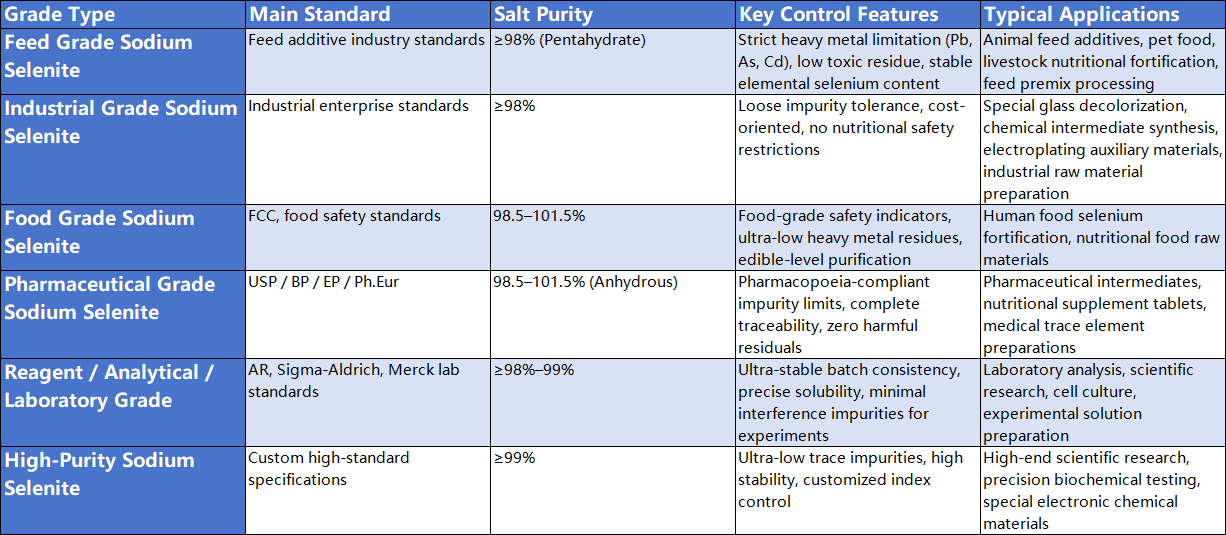
Sodium selenite, with the formula Na₂SeO₃ and CAS 10102-18-8, is an inorganic selenium(IV) salt supplied as anhydrous powder, micro-granulated feed additive, or pentahydrate crystalline solid. The anhydrous material has a formula weight of 172.94 g mol⁻¹ and a calculated selenium content of 45.65%; the pentahydrate Na₂SeO₃·5H₂O has a formula weight of 263.01 g mol⁻¹ and a calculated selenium content of 30.02%. Product models are differentiated by hydration state and end-use classification: feed-grade 45.5% Se granulated selenite for premix manufacture, glass-grade decolorizing powder for container and float glass batch, and purified material for compendial trace element preparation. In animal feed, the substance is regulated as a nutritional selenium source under 21 CFR 573.920 and under European Union feed additive identification code 3b801 within Regulation (EC) No 1831/2003. The material is not a direct feed ingredient because its selenium concentration is too high for uniform dosing; it is pre-diluted into a mineral premix and then metered into complete feed to achieve a final selenium concentration of 0.3 mg/kg in United States formulations or 0.5 mg/kg in most EU livestock complete feeds. Theoretical selenium fractions are fixed by stoichiometry, but commercial certificates of analysis normally require assay not less than 98.0% Na₂SeO₃ on the dried basis and selenium content within ±0.5 percentage points of theoretical.
Representative supplier data sheets list the following physico-chemical controls for the anhydrous material: white crystalline powder, water-insoluble matter ≤0.05%, chloride ≤0.05%, sulfate ≤0.1%, arsenic ≤2 mg/kg, lead ≤2 mg/kg, and loss on drying ≤0.5% after 105 °C drying. The pentahydrate is expected to release its five water molecules; the theoretical water fraction is 34.24%, and loss-on-drying values of 34–36% are used for batch release when assay is expressed on the pentahydrate basis. Selenium content is measured by hydride-generation atomic absorption spectrometry following acid digestion, with EN 16159:2012 referenced for animal feed matrices.
| Parameter | Anhydrous grade | Pentahydrate grade |
|---|---|---|
| Formula weight | 172.94 g mol⁻¹ | 263.01 g mol⁻¹ |
| Selenium content, theoretical | 45.65% | 30.02% |
| Assay, Na₂SeO₃ on dried basis | 98.0–101.0% | 98.0–101.0% |
| Loss on drying | ≤0.5% | 34–36% |
| Chloride, Cl | ≤0.05% | ≤0.05% |
| Sulfate, SO₄ | ≤0.1% | ≤0.1% |
| Arsenic | ≤2 mg/kg | ≤2 mg/kg |
| Lead | ≤2 mg/kg | ≤2 mg/kg |
The selenite salt is used in glass batch as a selenium source for decolorization of iron-green tint. In a soda-lime-silica furnace operating at 1,450–1,550 °C, Fe²⁺ derived from sand and cullet produces a broad absorption around 1,050 nm; the addition of oxidized selenium shifts iron toward Fe³⁺, which suppresses the green transmission. Sodium selenite differs from selenium dioxide in batching behaviour. SeO₂ sublines at 315 °C under atmospheric pressure, whereas the sodium salt retains selenium as a non-volatile solid until decomposition in the furnace charge. This reduces fugitive selenium loss during weigh-belt blending and doghouse charging. The salt can be pre-dissolved in deionized water and injected through liquid batch systems, a practice not equally applicable to solid SeO₂ because of its volatility and its hydrolysis product, selenious acid.
Process control is narrow. Glass redox state is monitored through batch redox adjustment; when cullet ratio increases above 60% or when carbon-bearing contamination enters from recycled glass, the melt can become reducing and selenium is lost as volatile selenide species instead of remaining in the oxidized decolorizer form. Published data for specific furnace configurations are limited, but the operational boundary is managed by limiting reducing cullet and by measuring selenium retention in the glass rather than assuming batch addition is quantitative.
In feed trace mineral formulation the product is classified as a high-potency selenium source, and the pure salt is not added directly to final feed. A powder premix is typically prepared at 100–1,000 mg Se/kg by dispersing sodium selenite into calcium carbonate, wheat middlings, or silica carriers. The premix is then metered into a horizontal ribbon mixer or twin-shaft paddle mixer at a rate calculated to deliver 0.3 mg Se/kg complete feed under 21 CFR 573.920, or 0.5 mg Se/kg complete feed under EU classification 3b801. Homogeneity is assessed by taking 10–20 cross-cut samples according to ISO 6497:2002 and analyzing selenium by acid digestion followed by hydride-generation atomic absorption spectrometry using EN 16159:2012. Batch release typically requires a coefficient of variation below 5% for trace mineral assays. Published data for specific ribbon-mixer recovery rates is limited; however, static charge agglomeration at relative humidity below 20% is recognized as a handling boundary because anhydrous powder can adhere to polymer transfer hoses and rotary valve pockets, reducing delivered selenium until grounded stainless-steel conveying lines are used.
In aqueous supplement manufacturing, sodium selenite is dissolved to form selenite ion, SeO₃²⁻, in alkaline or neutral solution. Sodium selenate, Na₂SeO₄, CAS 13410-01-0, contains selenium in the +6 oxidation state, has a lower theoretical selenium fraction of 41.78%, and is more water-soluble than the selenite salt in cold water; however, its reduction kinetics in biological systems and in glass melts are slower than selenite. Selenium dioxide, SeO₂, CAS 7446-08-4, has a theoretical selenium fraction of 71.15% but is a volatile, acidic oxide that forms selenious acid on contact with water. These differences determine the allowable application: feed regulations list sodium selenite and sodium selenate separately, with selenite more commonly used in dry premixes because of lower hygroscopicity and more reproducible flow through micro-ingredient dosing systems; selenium dioxide is not listed as a direct nutritional selenium salt in the same feed categories and is primarily a glass and chemical intermediate.
| Property | Sodium selenite | Sodium selenate | Selenium dioxide |
|---|---|---|---|
| CAS number | 10102-18-8 | 13410-01-0 | 7446-08-4 |
| Formula | Na₂SeO₃ | Na₂SeO₄ | SeO₂ |
| Formula weight, g mol⁻¹ | 172.94 | 188.94 | 110.96 |
| Theoretical selenium, % w/w | 45.65 | 41.78 | 71.15 |
| Selenium oxidation state | +4 | +6 | +4 |
| Water interaction | Soluble; forms alkaline selenite solution | Soluble; forms alkaline selenate solution | Hydrolyzes to selenious acid |
| Primary glass use | Decolorizer and oxidizing agent | Rarely used | Decolorizer and redox agent |
| EU feed additive code | 3b801 | 3b802 | Not listed as nutritional selenium salt |
Storage conditions are controlled by hydration state and reduction chemistry. Anhydrous sodium selenite is less hygroscopic than the pentahydrate, but both grades form compacted lumps if exposed to alternating high and low humidity. Sacks should be kept closed at relative humidity below 60% and below 30 °C; pentahydrate material can lose water of crystallization at elevated temperatures, shifting batch assay and flow behaviour in volumetric screw feeders. The product is incompatible with strong reducing agents and acidic reagents: in acid solution, selenite is reduced to elemental selenium as a red-brown precipitate, and in liquid feed supplements containing ascorbic acid or reducing sugars, this reaction lowers bioavailable selenium and produces sediment that clogs 0.2–1.0 mm nozzle ports in liquid dosing systems. Sodium selenite is classified as toxic by ingestion and skin contact under CLP; occupational handling therefore requires dust extraction at bag dump stations, P3 particulate respirators where airborne dust exceeds local occupational exposure limits, and nitrile glove protection. These boundaries are observed in premix plants and glass batch houses handling selenite-containing formulations.